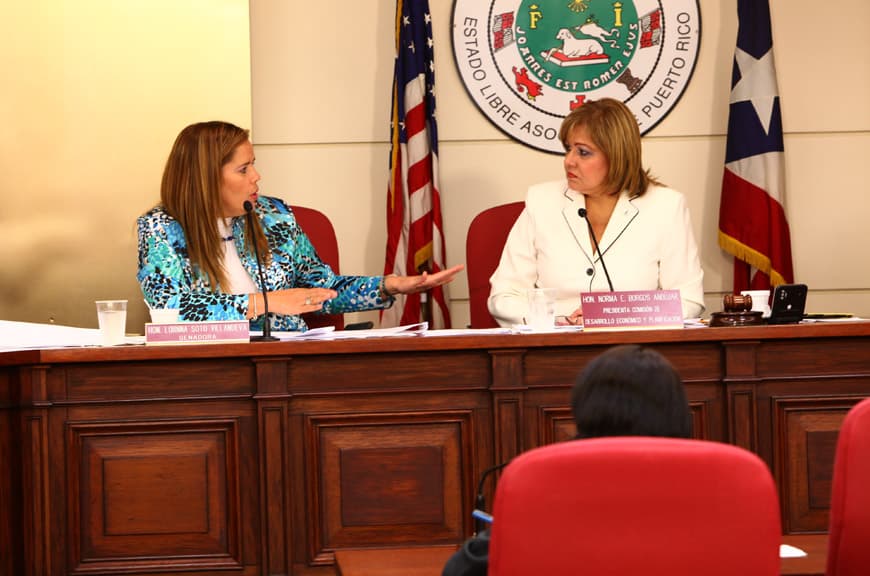
The San Juan delegation of the Popular Democratic Party (PDP) on Sunday accused the capital city’s government of engaging in “a pattern of fiscal negligence” following the Financial Oversight and Management Board’s approval of a $323.7 million municipal bond issue. According to PDP leaders, $209 million of the transaction will refinance debt dating back as […]
The San Juan delegation of the Popular Democratic Party (PDP) on Sunday accused the capital city’s government of engaging in “a pattern of fiscal negligence” following the Financial Oversight and Management Board’s approval of a $323.7 million municipal bond issue.
According to PDP leaders, $209 million of the transaction will refinance debt dating back as far as 2007—an approach they argue delays repayment and shifts the financial burden onto future generations of San Juan residents.
Ingrid Colberg Rodríguez, the PDP spokesperson in the San Juan City Assembly, said the board’s determination “will transfer the burden and compromise future generations of San Juan residents.” She added that annual payments appear lower only because “60 percent of the debt is not being paid down but postponed,” warning that in 2033 the city faces a balloon payment of $123.9 million.
“That is not responsible fiscal management,” Colberg Rodríguez said. “Instead of correcting that legacy, Mayor Miguel Romero perpetuates it, extends the maturity dates of debt that has been circulating for two decades, amortizes it minimally and transfers it in full to those who govern after him. This is exactly what the central government did before Title III: live on credit and let others pay the bill.”
PDP Secretary General Manuel Calderón Cerame echoed the criticism, saying the refinancing “repeats the pattern of negligent fiscal administration that led Puerto Rico’s central government into bankruptcy: borrowing today, deferring payment into the future, and presenting it as if it were an achievement.”
Both leaders argued that San Juan’s fiscal position does not justify refinancing. They pointed to increased municipal license tax collections and other revenue gains over the past four to five years.
“When revenues rise, the sensible thing to do is reduce debt, not defer it,” Colberg Rodríguez said.
The PDP delegation also highlighted demographic risks outlined in the oversight board’s certified fiscal plan, which projects a 17 percent population decline between 2029 and 2053 and an accelerated aging of the tax base.
“The San Juan community that will have to pay the $123.9 million in 2033 will be smaller than today’s,” they said, adding that extraordinary revenues from 2020 to 2026—boosted by federal pandemic relief and nonrecurring construction activity—cannot be assumed in future years.
They further noted that a second ordinance filed the same day seeks an additional $123.5 million financing, without addressing any of the long‑term risks they identified.
Colberg Rodríguez said she formally requested that the oversight board postpone authorization until an independent and transparent evaluation was completed. The board approved the financing the same day the ordinances were submitted.
“Decisions on public debt cannot be evaluated from the perspective of who governs today; they must consider who pays tomorrow,” she said. “The mayor benefits now and commits future San Juan residents.”
Asked for comment, Betsy Nazario, director of the Municipality of San Juan’s Office of Press and Communications, rejected the PDP’s criticism and said the administration would not be sidetracked by partisan disputes.
“We respect the right of all sectors to express themselves. However, we are not going to distract ourselves by paying attention to press conferences that do not offer solutions, do not present ideas, and do not contribute to addressing the challenges faced by San Juan residents,” Nazario said.
“At a time when the city faces important challenges, the last thing Sanjuaneros need is for every issue to become a political controversy. Our priority will continue to be working, executing projects, and developing initiatives that improve quality of life. When the government functions, people see it, understand it, and feel it in their daily lives. That will always be the best measure of our work.”
The municipal administration emphasized that San Juan has posted five consecutive operating surpluses, has significantly strengthened its liquidity, and has received the Distinguished Budget Presentation Award from the Government Finance Officers Association for four straight years.
“Instead of paying more for the same debt, this administration chose to pay less, save approximately $84 million, and put those resources to work for the people. Citizens have the right to demand that their government manage every dollar responsibly. That is precisely what this refinancing accomplishes: paying less for the same debt in order to invest more in the community,” the municipality concluded.